Production
We believe in lean manufacturing practices, quality products and on-time delivery performance. This is what made us excel in the thermoplastics injection molding, bmc and composites production.
Insert Overmoulding & Robotic Multi-Material Moulding
DASYC produces overmoulded and insert-moulded technical parts in Greece for customers across Europe and North America. Our robotic overmoulding cells combine two injection moulding machines with a six-axis FANUC robot, so a metal insert, a second material and the base part come together in one automated process. You get the result of 2K moulding without the cost of a 2K machine and 2K tooling.
What we overmould
- Metal inserts: washers, threaded inserts, nuts, pins, contacts and stamped metal parts
- Two-material parts: clear and opal, hard and soft, two colours, or a transparent window in an opaque housing
- Electrical and electronic components: terminal covers, housings and parts with moulded-in conductive inserts
- Functional assemblies: parts where overmoulding replaces screws, clips, glue or a separate assembly step
How our robotic overmoulding works
- The robot loads the metal insert into the first mould.
- Machine 1 moulds the first shot, for example the opal body.
- The six-axis FANUC robot transfers the part to the second mould.
- Machine 2 overmoulds the second material, for example the clear window, around the first shot and the insert.
- The robot removes the finished part for inspection and packing.
The whole cycle runs automatically, with the same robot path every shot. That repeatability keeps insert position, bond quality and cosmetic finish consistent over hundreds of thousands of parts.
Robotic overmoulding vs 2K moulding
- Machines: two standard injection moulding machines and a robot, instead of a dedicated 2K machine
- Tooling: two simpler single-shot moulds instead of one complex rotary or core-back mould, so lower tooling cost
- Metal inserts: placed automatically by the robot in the same cycle
- Flexibility: the machines can also run single-shot jobs when needed
Proven in series production
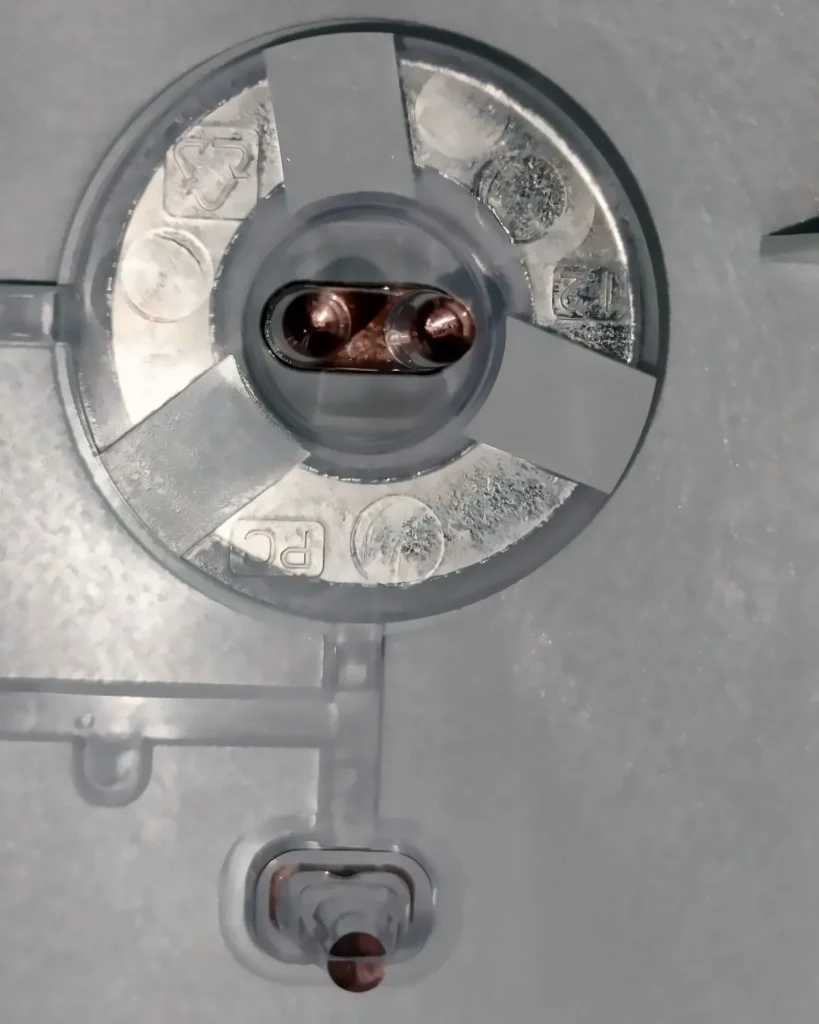
Our first robotic overmoulding cell produces electricity-meter top covers that combine a clear and an opal material with a ferrous washer in a single automated process. We now run several series projects with this technology for customers in the energy-metering and electrical industries.
Materials
We overmould engineering thermoplastics such as PC and PA, and advise on material pairs that bond well, shrink compatibly and meet your flame-retardancy or UV requirements.
From design to series production
- DFM review: we check insert retention, shut-offs, wall thickness and bond areas before the tool is built
- In-house tool design and toolshop: we design the moulds and maintain them on site
- Automation: robot programming done in-house
- Assembly and packing: post-moulding operations in the same plant
We also offer BMC thermoset moulding and composite parts, so complex assemblies can come from one EU supplier.
Frequently asked questions
What is insert overmoulding?
Insert overmoulding, also called insert moulding or insert molding, is moulding plastic around a pre-placed part, usually metal, so the insert is permanently locked into the plastic. It removes assembly steps such as pressing or screwing in inserts.
What is the difference between overmoulding and 2K moulding?
Both produce a part made of two materials. 2K moulding does it in one machine with a special mould. Robotic overmoulding uses two standard machines and a robot that transfers the part, which usually means lower tooling cost.
Can you take over an existing overmoulding project?
Yes. We can transfer existing tools after a review, or build new tools in our own toolshop.
Have a part that needs a metal insert or a second material?
Send us your 3D model and annual volume, and our engineers will reply with a DFM review and quotation.